Semaglutide and Tirzepatide Dosing Schedule: The Complete Titration Guide
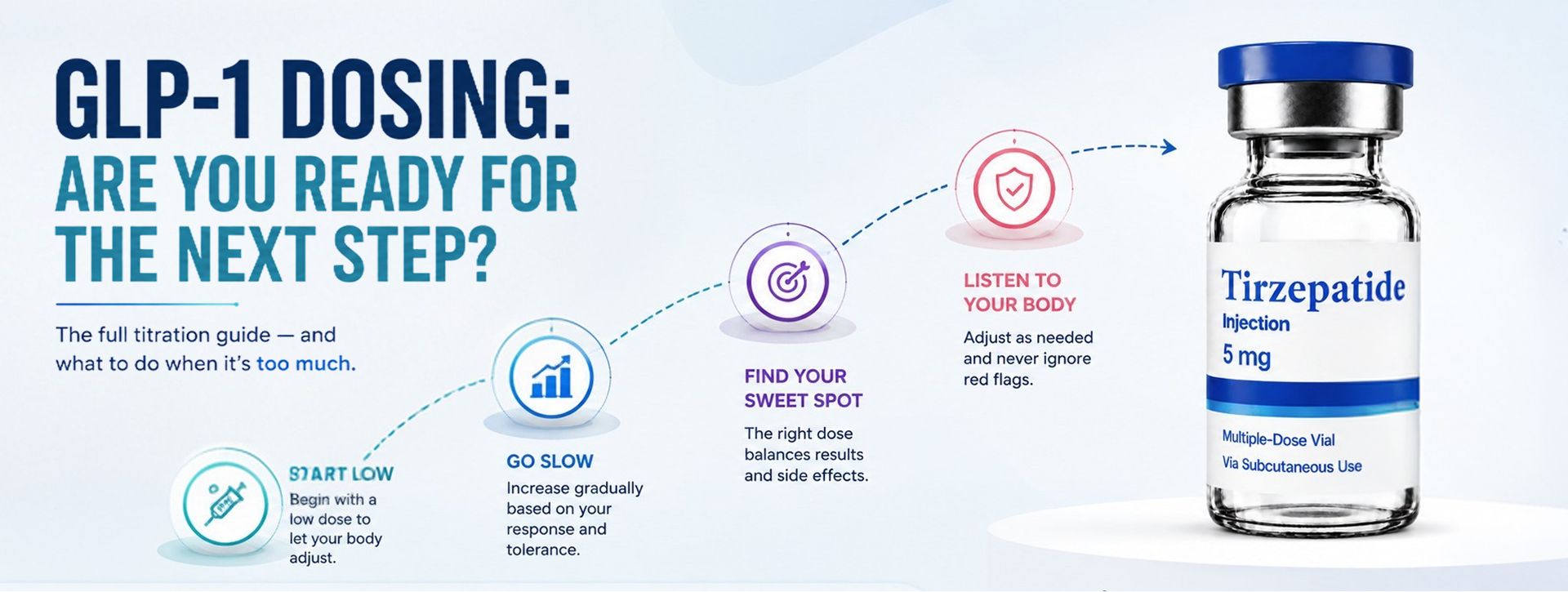
Both semaglutide and tirzepatide are started at a low dose and increased on a fixed schedule, holding each step for at least four weeks before moving up. That's the shared logic behind Wegovy, Ozempic, Zepbound, and Mounjaro. What most guides skip is the part patients actually ask about: what to do when a step is more than your body will take, and how that schedule translates when your treatment plan is compounded and physician-personalized rather than a fixed pen dose.
A note on compounded vs. brand-name dosing: The schedules below come from the FDA-approved labels for the branded medications Wegovy, Ozempic, Zepbound, and Mounjaro. They're the clinical reference point the entire industry titrates against. The GLP Doctor prescribes compounded semaglutide and tirzepatide, prepared by a US-licensed 503A compounding pharmacy — your prescribing physician builds your titration plan around the same evidence-based step-up principles, individualized to your response, tolerance, and goals.
What is the full semaglutide dosing schedule?
Semaglutide is a once-weekly GLP-1 receptor agonist sold as Wegovy for chronic weight management and Ozempic for type 2 diabetes. Both FDA labels start at 0.25 mg once weekly and hold each step for four weeks. Wegovy escalates to a 2.4 mg maintenance dose. Ozempic tops out at 2 mg.
Two label details worth knowing: the Wegovy label allows 1.7 mg once weekly to be used as the maintenance dose if 2.4 mg isn't tolerated, and it explicitly permits delaying an escalation by four weeks when a patient doesn't tolerate a step. Holding is written into the label — it isn't improvising.
What is the full tirzepatide dosing schedule?
Tirzepatide is a once-weekly dual GIP and GLP-1 receptor agonist sold as Zepbound for chronic weight management and Mounjaro for type 2 diabetes. Both FDA labels start at 2.5 mg once weekly for four weeks, move to 5 mg, then increase in 2.5 mg increments no sooner than every four weeks, to a 15 mg maximum.
Note the difference in how the two molecules define maintenance: Wegovy names one target dose, while Zepbound names three — meaning stopping at 5 mg or 10 mg is a labeled outcome, not a compromise.
How long do I stay on each dose?
Four weeks per step is the floor in every one of these labels, and it exists for tolerability rather than efficacy. Nothing stops a prescriber from holding you longer. Plenty of people spend eight or twelve weeks at a step, and some settle permanently below the maximum dose — which both the Wegovy and Zepbound labels explicitly allow for.
The four weeks is a minimum, not a schedule you owe anyone. If your weight is still moving and you feel fine, there's an argument for staying put rather than climbing on principle.
What should I do if a dose is too much?
You have three moves, and none of them means quitting: hold at the current dose past four weeks, step back down one level, or extend the interval between injections. The Wegovy label explicitly permits delaying escalation by four weeks for tolerability, and allows 1.7 mg as a maintenance dose when 2.4 mg isn't tolerated. Talk to your prescriber before changing anything.
Stepping back is not failure and it isn't a wasted month. The dose that works is the one you can actually keep taking — which is the whole point, given how many people discontinue a GLP-1 within the first year of treatment.
How The GLP Doctor Personalizes Your Titration Plan
Everything above is the clinical reference point. In practice, your titration plan is a conversation, not a fixed pen dose. Through The GLP Doctor's online consultation, a licensed physician reviews your health history, current dose (if you're switching from a branded product), and tolerance, then builds a compounded semaglutide or tirzepatide plan around the same step-up principles described above — adjusted to how you actually respond, not a one-size schedule.
Because dosing changes are a prescriber decision, ongoing support is where a compounded plan tends to work better for people who've had a rough step-up before: your provider can hold, step back, or adjust the interval as part of routine follow-up, without you having to start over with a new consultation.
Ready for a titration plan built around you? Start My Free Assessment →
Safety: milliliters are not milligrams
This is the dosing error that sends people to the emergency department, and it comes from the arithmetic rather than the drug. A brand pen dials in milligrams. A multi-dose compounded vial is labeled in milligrams per milliliter, and you draw a volume with a syringe marked in units — three different measures for one dose.
Work through it: a vial at 2.5 mg/mL means a 2.5 mg dose is 1.0 mL, which reads as 100 units on a U-100 insulin syringe. A vial at 5 mg/mL means the same 2.5 mg dose is 0.5 mL, or 50 units. If a refill arrives at a different concentration and you keep drawing the volume you're used to, you take double the dose you intended.
The FDA maintains a live, continuously updated record of adverse event reports for compounded semaglutide and tirzepatide through its FAERS public dashboard. Reported volumes have grown as compounded use has grown, which is exactly why concentration-checking matters every time — check the live dashboard for current figures rather than relying on a fixed number, since these counts update regularly.
What protects you
- Read the concentration on every new vial, every time — not the first one only.
- Have your prescriber or pharmacist confirm the dose in milligrams, milliliters, and syringe units in writing before your first injection from any new vial.
- Never carry over a unit count from a previous vial or a previous supplier.
- Use the syringe supplied with the vial — syringes are not interchangeable across concentrations.
- If a number doesn't reconcile, don't inject. Call first.
Compounded medications are not FDA-approved. The FDA does not review compounded drugs for safety, effectiveness, or quality. Product prepared by a licensed 503A compounding pharmacy still carries this measurement risk, because the vial format itself is what shifts the arithmetic onto you. It's also exactly why our pharmacy partners provide clear concentration labeling and why our care team confirms your dose in writing before every new vial ships.
What happens if I miss a dose?
The labels give different windows for the two molecules. For Ozempic, take a missed dose within five days, otherwise skip it. For tirzepatide — whether Zepbound or Mounjaro — take a missed dose within four days, otherwise skip it. For Wegovy, take it if the next scheduled dose is more than two days away, and skip it if it's sooner.
Missing several in a row is different from missing one. If two or more consecutive weekly Wegovy doses are missed, the label allows resuming at the prescribed dose or restarting the escalation schedule at a lower dose — a judgment call for your prescriber. The longer the gap, the more likely restarting low is the right answer, because tolerance to GI effects fades.
Can I change which day I inject?
Yes, on both molecules, provided at least 72 hours separate the last dose from the next one. That three-day minimum appears in the semaglutide and tirzepatide labels alike. After the switch, keep the new day fixed — consistency matters more to steady drug levels than which particular day you choose.
Pick a day that suits the side effect pattern rather than your calendar habits. If nausea peaks on days one and two, injecting on a Friday puts the worst of it on the weekend for a lot of people.
What is a maintenance dose, and when do I reach one?
A maintenance dose is the dose you stay on once escalation stops. On Wegovy that's 2.4 mg once weekly, or 1.7 mg if the top dose isn't tolerated. On Zepbound the label names 5, 10, or 15 mg. Reaching it typically takes about 16 to 20 weeks of four-week steps, assuming no holds along the way.
Most people hold at least once. Plan for five or six months to maintenance rather than four, and treat anything faster as a bonus.
Who shouldn't take these medications at all?
Both semaglutide and tirzepatide carry a boxed warning for thyroid C-cell tumors based on rodent studies. Both are contraindicated in anyone with a personal or family history of medullary thyroid carcinoma or Multiple Endocrine Neoplasia syndrome type 2, and in anyone with a known serious hypersensitivity to the active ingredient. Neither is used in pregnancy.
Tell your prescriber about any history of pancreatitis, gallbladder disease, severe gastrointestinal disease including gastroparesis, diabetic retinopathy, or kidney impairment. Also flag every other medication you take — these drugs slow gastric emptying, which can change how other oral medications are absorbed, and anyone on insulin or a sulfonylurea may need those doses adjusted to avoid hypoglycemia.
This is exactly the kind of history your physician reviews during your online consultation before any dose is prescribed — titration only starts once it's established that treatment is appropriate for you.
Getting Started With a Physician-Guided Titration Plan
If you're weighing whether to start, or you're switching from a branded pen and want your schedule carried over correctly, the process is the same three steps throughout:
- Online Consultation — a licensed physician reviews your history and current dose (if applicable) and builds your starting plan.
- Fast, Free Delivery — your compounded medication ships from a US-licensed 503A compounding pharmacy, labeled with concentration and dose confirmed in writing.
- Ongoing Support — your provider adjusts your titration schedule as you go, so a rough step doesn't mean starting over.
New to GLP-1 treatment? Start My Free Assessment | Switching from a brand-name pen? Start My Switch Assessment →
Frequently Asked Questions
Do compounded semaglutide and tirzepatide follow the same titration schedule as Wegovy and Zepbound?
They follow the same evidence-based step-up principle — start low, hold at least four weeks, increase gradually — but the exact schedule is set by your prescribing physician based on your individual response, not a fixed FDA label, since compounded medications are prepared per prescription rather than mass-manufactured to a single dosing regimen.
Is it safe to switch from a branded pen (Wegovy, Ozempic, Zepbound, Mounjaro) to a compounded version?
Switches should always be reviewed by a physician first. Bring your current dose and injection history to your consultation so your provider can match or adjust your starting point rather than restarting the full titration schedule unnecessarily.
How do I know what concentration my compounded vial is?
It's printed on the vial label in milligrams per milliliter (mg/mL). Confirm it against the dose and syringe units your provider or pharmacist gave you in writing before every injection from a new vial — never assume it matches your last one.
What if my next dose is due but I'm still dealing with side effects from the last one?
Contact your prescriber before your next scheduled dose. Holding at the current dose, rather than escalating on schedule, is a standard and label-supported response to ongoing side effects.
Can I skip straight to a higher dose if I want faster results?
No. The four-week minimum between steps exists to let your body adjust and to reduce the risk of severe gastrointestinal side effects — skipping it increases risk without a proven benefit to long-term weight loss outcomes.